 4.4 Out of 259




 (214) 308-1106
  Book Online
Call 911 or go to an emergency room if your child’s lips or face look blue, if they are struggling so hard to breathe that the skin pulls in between or under the ribs, if they are grunting with each breath out, or if they cannot swallow or are drooling and refusing to lie down.
Urgent care is the right level for most other worrying coughs: a barking, seal-like cough with noisy breathing in, a cough with a fever that has run more than three days, a wet cough that got better and then clearly got worse, or a cough with fast breathing in a child who is otherwise alert. Any cough at all in an infant under three months warrants a call to your provider the same day.
The rest of it, the tickly night-time cough with a runny nose and a normal-acting child, is usually a watch-and-wait situation.
Here’s How To Read The Situation In The Middle Of The Night
Parents rarely have trouble telling that something is wrong. What is hard is deciding whether it is a wait-until-morning wrong or a get-in-the-car wrong, and that decision usually gets made while tired and worried.
Below is a way to sort it that clinicians use: watch the breathing first, then listen to the cough’s character, then factor in age and how long it has run. There is also a section on what actually happens at a visit, including when labs and X-rays or a chest X-ray genuinely change the plan and when it is unnecessary, since that is a question parents ask constantly and rarely get a straight answer to.
Watch The Breathing Before You Judge The Cough
A dramatic-sounding cough in a comfortable child is far less concerning than a quiet cough in a child who is working to breathe. So look at the chest and neck before anything else.
The signs that a child is working too hard are specific and visible once you know what you are looking at.
Retractions are the most useful of them. The skin pulls inward between the ribs, under the ribcage, or at the base of the neck with each breath, as though the chest is being sucked in. Grunting is a short sound at the end of each breath out, and in a young child it signals real respiratory effort rather than fussiness. Stridor is a high-pitched noise on inspiration, often accompanied by a barking cough. Alongside those, watch for nasal flaring, breathing clearly faster than this child’s normal, and any blue or dusky colour in the lips, tongue, or face.
Blue colour, grunting, severe retractions, or an inability to swallow are emergency-room findings, not urgent-care ones. Do not drive across town to a walk-in clinic with a child who is turning blue; call 911.
Lift the shirt to check. Retractions are easy to miss through pyjamas, and they are the finding that most often changes a clinician’s mind about how sick a child is.
One practical note on counting breathing rate, since parents are often asked about it on the phone. Count for a full minute while the child is calm and not crying, ideally asleep, because a crying child breathes fast for reasons unrelated to their lungs. Normal rates vary a lot by age, faster in infants and slower as children grow, so what matters more than hitting a specific number is whether this rate is noticeably faster than your child’s usual. A parent saying “she is breathing much quicker than normal for her” is more useful clinically than a number without context.
It is also worth knowing that a child can look reasonably comfortable and still be tiring. Watch for a child who has stopped playing entirely, who will not lie down, who is quiet in an unusual way, or who is too breathless to finish a sentence or a feed. Effort that has gone on for hours is its own risk, because small children have limited reserve and fatigue is what turns a manageable illness into an emergency.
What The Cough Sound Actually Tells You
Once you have established that breathing is not in crisis, the character of the cough narrows things considerably. Clinicians pattern-match on this constantly.
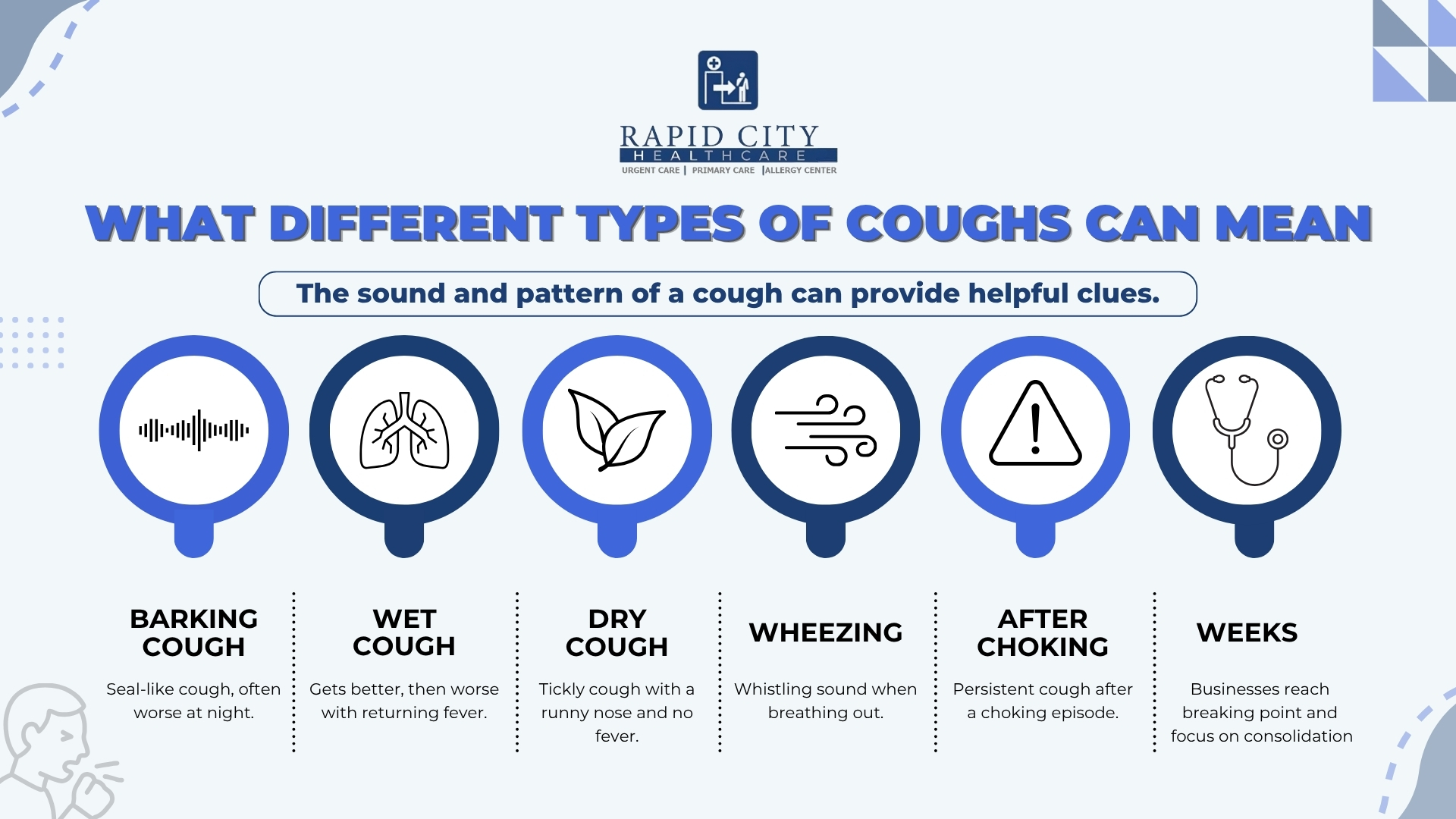
A barking, seal-like cough, usually worse at night and often with a hoarse voice and noisy breathing in, is the classic croup picture. It is viral, extremely common in toddlers, and it frightens parents more than almost anything else. Mild croup is often managed without imaging at all. Croup with stridor while the child is at rest, rather than only when upset, moves up the urgency scale.
A wet, productive cough that improved and then worsened, especially with a returning fever, is the pattern that most often prompts a chest x-ray. That double-worsening course is the one to mention explicitly when you call.
A dry, tickly cough with clear runny nose and no fever, in a child who is playing normally, is usually a simple viral upper respiratory infection.
A cough with wheezing, a whistling sound on the way out, points toward the lower airways and matters especially if there is any history of asthma or a previous episode like it.
A sudden choking episode followed by persistent coughing in a toddler who was previously well needs to be evaluated regardless of how well they look afterwards, because an inhaled object does not resolve on its own.
A cough lasting more than three weeks is worth a visit even if each individual day seems mild.
When A Chest X-Ray Is Actually The Useful Step
This is where a walk-in clinic with imaging on site changes the visit, and it is worth being honest about how often that applies.
Most childhood coughs do not need an X-ray. Viral illness, croup, and ordinary colds are diagnosed clinically, by examination and history, and imaging adds cost and radiation without changing what happens next. A clinician who orders a chest film for every cough is not doing careful medicine.
An X-ray earns its place in a narrower set of situations: when the exam suggests pneumonia and the picture is unclear, when a fever has persisted several days without an obvious source, when a cough has dragged on for weeks without improving, when there is real concern about an inhaled foreign object, or when a child looks sicker than the history alone explains.
The practical advantage of on-site imaging is timing. When a chest film is genuinely indicated, having it done and read during the same visit means treatment starts that day instead of after a referral to an imaging centre and a wait for results. When it is not indicated, the right answer is still not to do it, and you should expect a clinician to explain why rather than simply ordering one because the machine is there.
If you are told an X-ray is needed, it is fair to ask what question it is meant to answer. There should be a specific one.
Parents often ask about radiation, and it deserves a straight answer rather than reassurance. A single chest film is a small dose, and when a clinician has a real question that imaging can settle, the information is worth far more than the exposure. The argument against unnecessary imaging is not mainly about radiation anyway; it is that an unnecessary test can turn up an incidental finding that leads to more tests, more worry, and no benefit to the child. That is the reason to want a specific question, not a general look.
What Usually Is Not The Answer
A few things come up in every cough conversation and are worth addressing directly, because acting on them wastes time that matters.
Antibiotics do nothing for a viral cough, which is the overwhelming majority of them, and a green or yellow nasal discharge is not evidence of a bacterial infection. It is a normal stage of a cold. Pressing for antibiotics for a cough that is following an ordinary viral course does not shorten it and carries its own downsides.
Over-the-counter cough and cold medicines are not recommended for young children, and they are a common source of accidental overdose because two products can contain the same ingredient. Check with a clinician or pharmacist before giving anything, particularly if you are combining a fever reducer with a cold preparation.
Honey can help soothe a night-time cough in children over one year old. It should never be given to an infant under twelve months because of the risk of infant botulism. That age line is firm.
Finally, a humidifier or cool night air often eases croup, and that is genuinely useful, but it is comfort care rather than treatment. If a child has stridor at rest, feeling a bit better in the cool air outside does not mean the visit can be skipped.
Urgent Care Or Emergency Room
Both have a role, and choosing badly costs either time or money.
| Situation | Where to go |
| Blue lips or face, grunting, severe retractions, cannot swallow, drooling and refusing to lie flat | 911 or emergency room |
| Any cough in an infant under 3 months | Call your provider the same day |
| Barking cough with noisy breathing in, child otherwise alert | Urgent care |
| Fever more than 3 days with a cough | Urgent care |
| Wet cough that improved then clearly worsened | Urgent care |
| Possible inhaled object, child now stable | Urgent care or emergency room, do not wait |
| Cough over 3 weeks, child well otherwise | Primary care or urgent care |
| Tickly cough, runny nose, no fever, playing normally | Watch at home |
Two additional flags belong on that list regardless of cough character: a child who is not producing normal wet nappies or is drinking very little, and a child who is unusually difficult to wake or is not interacting the way they normally do. Both are about the whole child rather than the cough, and both should move you toward being seen.
Trust the comparison you are making against your own child. Parents are the best instrument for detecting that something is off, and clinicians take “this is not how she usually is” seriously.
What A Visit Usually Involves
Knowing the shape of the visit takes some anxiety out of it.
Expect the standard checks first, including an oxygen saturation reading from a clip on the finger or toe, which is quick and painless. Then a listen to the chest, a look in the ears, nose and throat, and a count of the breathing rate while the child is calm. Bring the details that are hard to reconstruct on the spot: when it started, whether there has been fever and how high, whether anything was inhaled, what medications have been given and when, and whether anyone else at home or in the class is sick.
Most visits end with a diagnosis of a viral illness and instructions for home care, which is a good outcome even though it can feel anticlimactic after the effort of getting there. Ask before you leave what specifically should bring you back, so you have a threshold rather than another night of guessing.
For families in Irving, urgent care and pediatric care sit alongside on-site labs and X-rays, which is the arrangement that lets a cough visit finish in one stop when imaging turns out to be needed.
What to do next
The thing worth remembering from all of this is the order of operations: look at the breathing, then listen to the cough, then weigh age and duration. A child who is breathing comfortably and behaving normally can almost always wait until morning, whatever the cough sounds like. A child pulling in at the ribs, grunting, or changing colour needs emergency care immediately, and a barking cough with noisy breathing at rest needs to be seen today. If you are in the middle band and unsure, being seen is a reasonable use of a walk-in visit, and the team at Rapid City Healthcare would rather look at a well child than have you wait out one who is not.
This article is general information, not medical advice, and it cannot account for your child’s history. If you are worried, seek care.