 4.4 Out of 259




 (214) 308-1106
  Book Online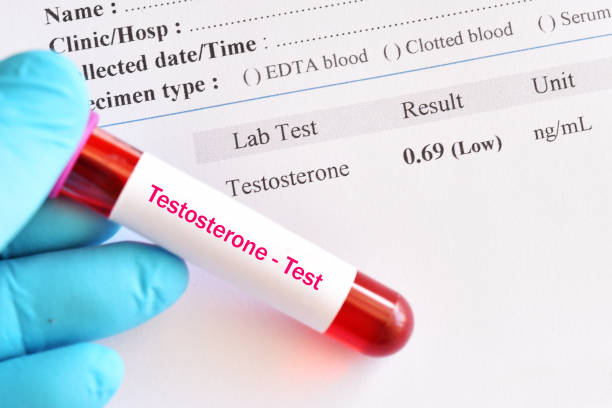
Getting tested for low testosterone is more specific than most people expect, and doing it wrong produces a misleading number. A single afternoon blood draw is not enough to make the diagnosis. Accessing the right Medical Services, a single afternoon blood draw is not enough to make the diagnosis. The clinical standard calls for two blood draws taken early in the morning, on separate days, read alongside your actual symptoms.
Low testosterone is diagnosed from bloodwork, but the how matters. Testosterone follows a daily rhythm and peaks in the early morning, so the American Urological Association recommends measuring total testosterone with an early-morning blood draw. Because levels vary day to day, the diagnosis should rest on two separate morning measurements, not one.
The AUA uses a total testosterone below 300 ng/dL as a reasonable cutoff supporting the diagnosis. Just as important, a low number alone is not enough. The diagnosis is made only when low levels are paired with symptoms or signs of low testosterone, things like low energy, reduced sex drive, or loss of muscle. This article walks through what low testosterone testing actually involves and how to start it in Irving.
What This Guide Covers
If you have wondered whether your fatigue, low libido, or brain fog might be low testosterone, the first step is a proper test, and knowing how it works keeps you from getting a wrong answer.
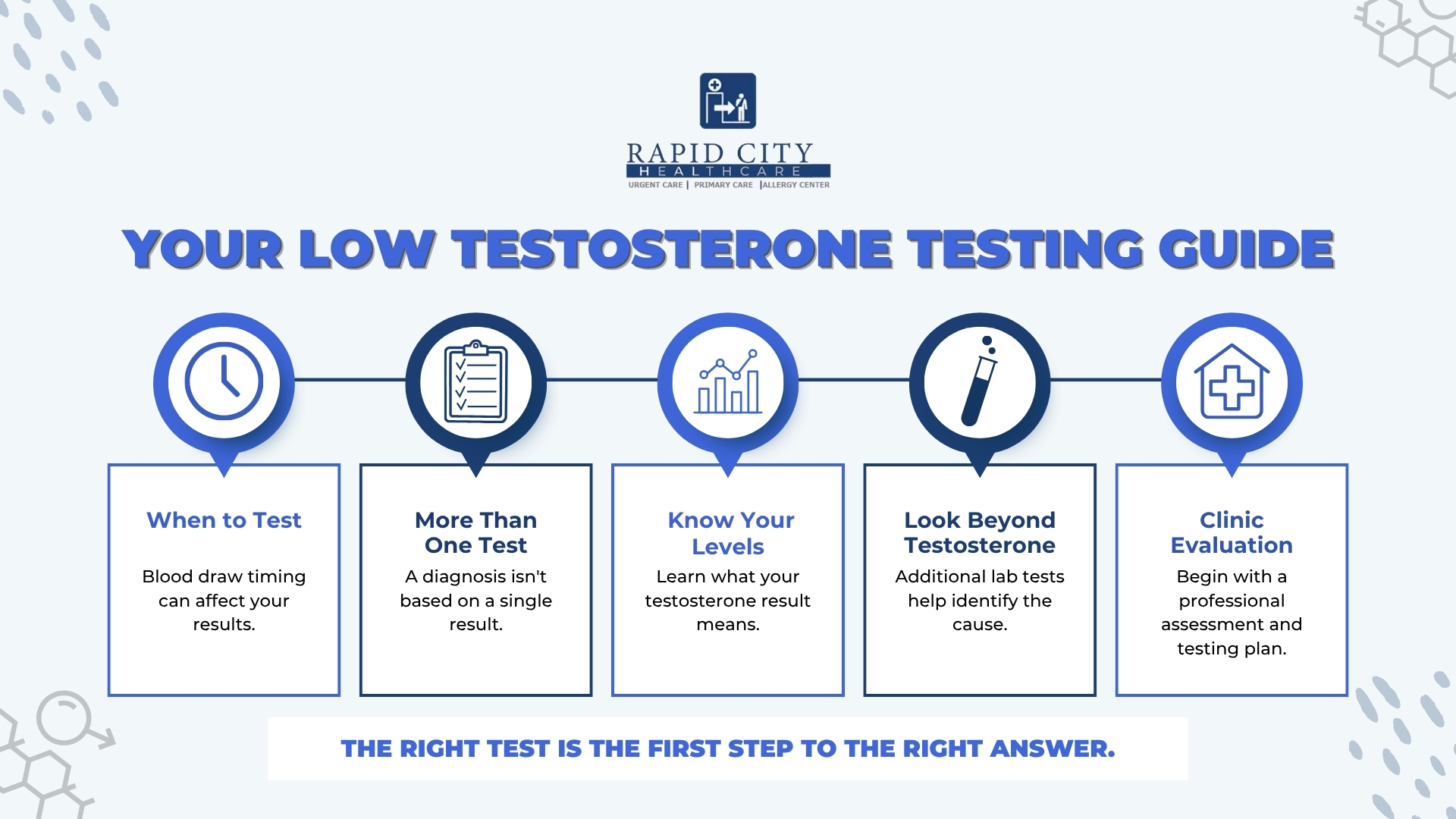
Below is why the timing of the blood draw changes the result, why one test is not enough to diagnose anything, what the actual number means and where the cutoff sits, which other labs a good workup includes beyond testosterone itself, and how the whole process gets started at a local clinic rather than through a mail-order kit.
Why The Timing Of The Test Matters So Much
Testosterone is not steady across the day. It runs on a circadian rhythm, highest in the early morning and drifting down as the day goes on. By afternoon, a perfectly normal man can post a number that looks low simply because of when the blood was drawn.
That is why the guideline is specific about timing. The AUA recommends the draw be done in an early-morning fashion, which is why a clinic will ask you to come in before roughly 10 am rather than fitting the test into a lunchtime visit. A test taken at 4 pm can read low on a man whose morning level is fine, and that mistake can send someone down a path of treatment they never needed.
The practical takeaway is simple: if a provider offers to check your testosterone with an afternoon draw and calls it done, that is a reason to ask questions. The time on the tube is part of the test, not an afterthought. Getting this one detail right is the difference between a meaningful result and a coin flip.
Why One Test Is Never Enough
Even a properly timed morning draw is only half the picture, because testosterone also varies from one day to the next. A single low reading can be a bad day rather than a real pattern.
For that reason, the diagnosis of low testosterone should be made only after two total testosterone measurements taken on separate occasions, both in the early morning. The AUA rates this a strong recommendation. Ideally, both draws go to the same lab using the same method, because different labs and instruments can report meaningfully different results for the same blood sample.
This is where mail-order kits and one-and-done clinics fall short. A single fingerstick or a single walk-in draw might flag a low number, but it cannot meet the two-measurement standard by itself, and it usually cannot control for the morning-timing and same-lab details either. A primary care relationship that can repeat the test correctly and track it over time is worth more than a fast answer that may not hold up.
What The Number Actually Means
When the results come back, the figure everyone fixates on is total testosterone, and the reference point most often cited is the AUA’s cutoff of 300 ng/dL. Below that, on two morning tests, supports a diagnosis of low testosterone. Above it, low testosterone is unlikely to be the explanation for your symptoms.
But total testosterone is not the whole story, and this is where a careful workup separates itself. Some of your testosterone is bound tightly to a protein called sex hormone-binding globulin and is not available to your body; the rest, the free and loosely bound portion, is what actually does the work. In certain men, total testosterone looks borderline while the usable fraction tells a different story, which is why a thorough evaluation may look at free testosterone and SHBG as well, not just the headline number.
The number also has to be read against you specifically. A result that is low for a 30-year-old may be ordinary for a much older man, and the symptoms matter as much as the value. This is exactly why the guideline insists on pairing the labs with signs and symptoms rather than treating from a number alone.
The Rest Of The Workup, Beyond Testosterone
A responsible low testosterone evaluation orders more than a single hormone, because the point is to understand why a level is low and to rule out things that change the plan. The exact panel is a clinical decision, but the workup commonly extends beyond testosterone to include several related markers.
LH and FSH, two pituitary hormones, help distinguish whether a low level originates in the testes or higher up in the brain’s signaling. Prolactin is often added, because an elevated level can point to a pituitary cause worth investigating before anything else. A complete blood count gives a baseline, since testosterone therapy can raise red blood cell counts and that needs watching. For appropriate ages, PSA and a prostate discussion come into it, because prostate health factors into any treatment decision. And in some cases estradiol, thyroid, and metabolic labs round it out, because fatigue and low libido have many possible drivers beyond testosterone.
The reason this breadth matters is that low testosterone is sometimes a symptom of something else, and sometimes the symptoms a man blames on it turn out to be thyroid, sleep, medication, or metabolic issues instead. A workup that only measures testosterone can miss all of that. This is the kind of evaluation that belongs with a clinician doing on-site lab testing and reviewing the whole picture, not a single-marker screen.
How To Prepare For The Blood Draw
A few simple things make the result more reliable, and they cost nothing but a little planning.
Go in the morning, ideally before 10 am, and try to keep it consistent between the two draws so you are comparing like with like. If your clinic asks you to fast, follow that, since some of the companion labs read more cleanly fasting. Be honest about any supplements and medications you take, because several can move the numbers: certain over-the-counter “test booster” supplements, opioids, some steroids, and even a biotin supplement can distort particular assays. A short list of what you take, brought to the visit, spares everyone guesswork.
Timing around illness and sleep matters too. An acute illness, a very stressful stretch, or a run of terrible sleep can temporarily suppress testosterone, so a result taken in the middle of the flu is not a fair reading. If you have been acutely unwell, it is often worth waiting until you have recovered before drawing, or at least flagging it so the provider can weigh the number with that context in mind. None of this is about gaming the test. It is about making sure the number reflects your baseline rather than a bad week.
What If The Test Comes Back Normal
Plenty of men who get tested for low testosterone turn out to have a normal level, and that is a useful result rather than a dead end.
If the symptoms are real but the testosterone is fine, the honest conclusion is that something else is driving them, and that something is often very treatable. Poor sleep, and obstructive sleep apnea in particular, produces fatigue, low libido, and brain fog that mimic low testosterone almost exactly. Thyroid problems, depression, anemia, uncontrolled blood sugar, high stress, and the side effects of common medications all land in the same symptom territory. Chasing testosterone when one of these is the real cause wastes time and misses the actual fix.
This is the strongest argument for having the evaluation done by a clinician who can look at the whole picture rather than by a service that only sells testosterone. A place whose only product is treatment has little reason to tell you the problem is your sleep. A primary care setting that can pivot to investigating the real cause is doing you a bigger favor than a low number and a quick prescription would. A normal result, read properly, points you at what to look into next instead of leaving you stuck.
How To Start The Process In Irving
The good news is that the correct version of this is straightforward and local. You do not need a specialist referral to begin.
It starts with a conversation about symptoms. Low energy, reduced sex drive, difficulty with erections, loss of muscle or increased body fat, low mood, and poor concentration are the common ones. Bringing a clear account of what you have noticed and for how long gives the visit a foundation, because the labs are interpreted against those symptoms.
It helps to be specific rather than general. “I have no energy” is a start, but “I used to run three times a week, and now I can barely get off the couch after work, and it has been about eight months” tells a provider far more. The same goes for libido, mood, and concentration: a concrete before-and-after, with a rough timeline, separates a genuine change from the ordinary ups and downs everyone has. If a partner has noticed changes too, that outside observation is worth mentioning. These details do not just help the diagnosis; they help decide whether treatment is worth pursuing later, since the goal is to improve how you feel, not to chase a number for its own sake.
From there, the clinic schedules an early-morning blood draw, repeats it on a second morning to meet the two-measurement standard, and adds the supporting labs that make sense for you. Then you sit down with a provider to go through what the numbers mean together, which is where a clinic with an on-site lab and its own medical providers has an advantage: the testing, the interpretation, and the next-step conversation happen in one place rather than scattered across a lab chain and a telehealth script.
If the results and symptoms do point to low testosterone, that opens a separate conversation about whether treatment is appropriate and what monitoring it requires, which is its own decision to make with a clinician. The testing is simply the honest first step, and getting it done properly is what makes everything after it trustworthy.
Where to go from here
The short version is that getting tested for low testosterone is a specific process, not a single blood draw: an early-morning sample, repeated on a second morning, read against your symptoms, with a cutoff around 300 ng/dL and a workup that looks past testosterone alone. Done that way, the result actually means something. Done casually, it can send you toward treatment you do not need or miss a level that does. If your symptoms have you wondering, the team at Rapid City Healthcare can run the testing correctly here in Irving and walk you through what the numbers show.
This article is general health information, not medical advice. Testing and any treatment decisions should be made with a qualified clinician who knows your history.