 4.4 Out of 259




 (214) 308-1106
  Book Online
Most sore throats are viral and will settle on their own. A small share are strep, and those need a test and a prescription. The frustrating part is that the two feel similar to the person who has one, which is why guessing is a poor strategy in both directions. There is, though, a short list of symptoms that argues fairly reliably against strep, and most people have it backwards.
TL;DR
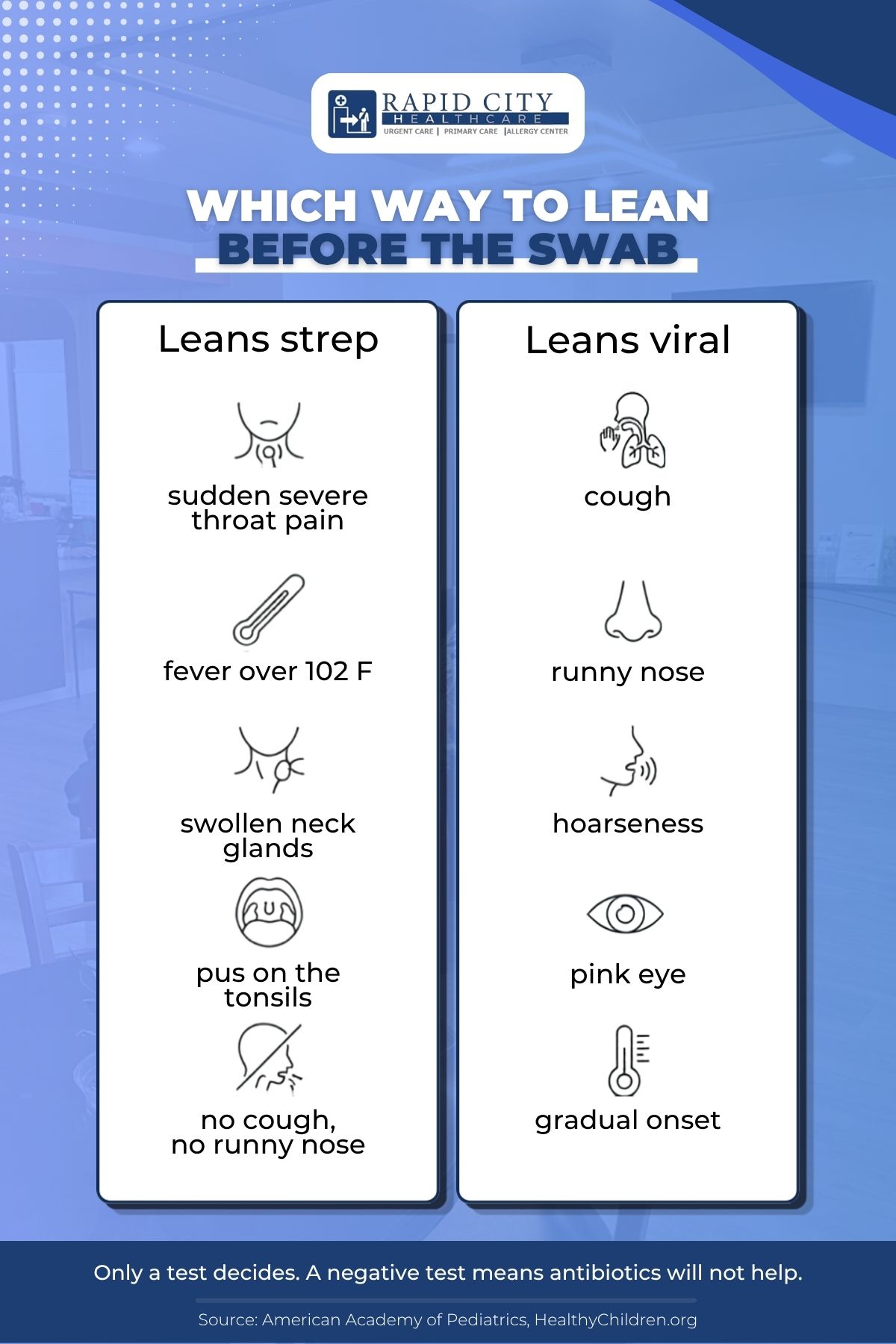
Cough, runny nose, hoarseness, and pink eye are not strep symptoms. When they show up alongside a sore throat, a virus is the more likely explanation. Strep tends to look like a very painful throat with a fever over 102, swollen neck glands, and pus on the tonsils, without the cold symptoms. Only a test settles it; the test takes minutes, and a negative result means antibiotics will not help. If you are in Irving and unsure, a walk-in visit resolves it the same day.
The Symptoms That Point Away From Strep
This is the single most useful thing on this page, and it surprises most parents.
The American Academy of Pediatrics is direct about it. Writing about the difference between a sore throat, strep and tonsillitis, the Academy states that “cough, runny nose, hoarseness (changes in your voice that make sound raspy) and conjunctivitis (also called pinkeye) are not symptoms of strep throat. If your child has these symptoms, a virus may be the cause of illness instead.”
So the sore throat that arrives with a stuffy nose and a cough, the one that feels like the beginning of a cold, is usually exactly that. People often read the combination as “this is getting worse, it must be strep,” when the combination is the argument for the opposite conclusion.
That matters here because of what we actually see people searching. Sore throat with chest congestion is one of the most common ways this gets described to us, and that particular pairing is a viral picture far more often than a bacterial one.
What Strep Tends to Look Like Instead
Strep throat is an infection with a specific bacterium, group A *Streptococcus*. The Academy notes it is most common among school-age children and adolescents, peaking around age 7 or 8.
In children over three, the Academy describes the presentation as an extremely painful throat, fever over 102 degrees Fahrenheit, swollen glands in the neck, and pus on the tonsils.
| Points toward strep | Points toward a virus |
| Sudden, severe throat pain | Gradual onset alongside a cold |
| Fever over 102 F | Mild or no fever |
| Swollen, tender neck glands | Cough |
| Pus or white patches on the tonsils | Runny or stuffy nose |
| No cough, no runny nose | Hoarseness, pink eye |
| School-age child, roughly 5 to 15 | Any age, very common under 5 |
Read that table as a lean, not a verdict. Plenty of real strep cases do not read from the textbook, and plenty of miserable viral sore throats look alarming. The table tells you which way to bet before a test, not what you have.
The age point is worth dwelling on, because it does more work than people expect. Strep is uncommon in toddlers and preschoolers, where the Academy notes viral infection is the most frequent cause of a sore throat, and children generally are not very sick with it, recovering over seven to ten days. It climbs through the school years and peaks around seven or eight. So the same symptom list means something different in a three-year-old than in a nine-year-old, and a household with school-age children in the middle of a classroom outbreak is in a different position again.
Adults get strep too, less often than school-age children, and frequently catch it from a child in the house. If a parent develops a severe throat a few days after a confirmed case at home, that history is part of the picture and worth mentioning at the desk.
Why Nobody Should Diagnose This by Eye
Because the overlap is genuine, and because getting it wrong is costly in both directions.
MedlinePlus, the patient-facing service of the National Library of Medicine, puts the core rule plainly: Most sore throats are caused by viruses, not bacteria. A sore throat should be treated with antibiotics only if the strep test is positive.
Treat a virus with antibiotics, and you get side effects, cost, and a contribution to resistance, with no benefit to the illness. Miss a real strep infection and the risks are different: the Academy notes that untreated or incompletely treated strep can worsen or spread, leading to abscesses around the tonsils or kidney problems, and can lead to rheumatic fever, which affects the heart. It also notes rheumatic fever is rare in the United States and rare under five years old.
That is the honest framing. Not a scare, and not a shrug.
What the Test Actually Involves
A rapid strep test is a swab of the back of the throat and the tonsils. It is uncomfortable for a few seconds, and it is over.
Most offices, ours included, run these in-house and read the result within minutes. If it is positive, that is the answer and treatment starts.
A negative result is where the nuance sits. MedlinePlus notes the rapid test “may be negative, even if strep is present,” and that when a clinician still suspects strep, a throat swab can be sent for culture, with results in one to two days. The Academy describes the same two-step sequence: rapid test first, culture to confirm a negative when the picture warrants it.
If the rapid test is negative and nothing about the exam suggests otherwise, the Academy is clear that the infection is presumed viral, and that antibiotics “will not help and need not be prescribed.”
Asking whether a culture is being sent is a reasonable question, and any clinician should be happy to explain why it is or is not.
One more thing about a negative result that is worth understanding rather than resenting. A negative test is a useful answer, not a wasted visit. It rules out the one cause of a sore throat that changes treatment, and it means the discomfort can be managed for what it is. MedlinePlus lists the measures that help a viral sore throat: warm liquids such as tea with honey, gargling with warm salt water, cold liquids or ice pops, a cool-mist humidifier, and over-the-counter pain relief. It also flags that young children should not be given lozenges or hard candies because of the choking risk.
People sometimes leave a negative visit feeling fobbed off. The opposite is true. Knowing that a throat is viral means knowing it should improve over roughly a week, and knowing what would count as it not improving.
If It Is Strep, Finish the Course
Two details that get skipped, and both come straight from the sources.
Antibiotics for strep run for 10 days; MedlinePlus notes, “even though symptoms are often gone within a few days.” Penicillin or amoxicillin is usually first. The Academy makes the same point about completing the course and explains the reason: an infection that is not fully treated can worsen or spread.
The second detail is contagiousness, and it is the one working parents need. Most people with strep can spread it until they have been on antibiotics for 24 to 48 hours, MedlinePlus says, and should stay home from school, daycare, or work until they have been on antibiotics for at least a day.
There is also a small practical instruction that is easy to follow and easy to forget: replace the toothbrush after two or three days, before the course is finished, so the bacteria are not sitting on it waiting.
Not Every Sore Throat Is One of These Two
A few other things produce a sore throat, and they change what the visit is about.
The Academy notes Coxsackievirus, seen most often in summer and fall, can bring a higher fever, more difficulty swallowing, a sicker overall feeling, and blisters in the throat and on the hands and feet. That is the hand, foot, and mouth picture, and the seasonality means late summer and autumn in Texas is exactly when it turns up.
Mononucleosis can produce a sore throat along with tonsillitis, though the Academy notes most young children infected with the mononucleosis virus have few or no symptoms.
Tonsillitis itself is swelling of the tonsils rather than a diagnosis of cause. It can be viral or bacterial, which is why “he has tonsillitis” describes rather than answers.
And a sore throat in North Texas in September is often not an infection at all. Cedar, ragweed, and grass seasons overlap here, and postnasal drip produces a genuinely sore throat, usually worse in the morning and better after fluids. We have written separately about telling allergies apart from a cold or COVID, because in this metro that is a real and frequent question.
When to Be Seen, and When to Be Seen Quickly
The Academy sets a low bar for calling, and we would rather people use it.
Call about a sore throat that persists, meaning one that does not clear after the first drink in the morning, whether or not there is fever, headache, stomach ache, or extreme fatigue.
Some things move faster than a phone call. The Academy names them: a child who seems extremely ill, who has difficulty breathing, or who has extreme trouble swallowing to the point of drooling. Drooling in a child with a sore throat is a red flag rather than a symptom to monitor, because it can indicate a more serious infection such as epiglottitis. That is an emergency department situation, not a walk-in one.
Between those two poles sits most of what we see. A sore throat that is bad enough to disrupt sleep, eating, or school, where the family wants an answer rather than another day of guessing. That is what a walk-in visit is for, and in Irving you can walk into urgent care without an appointment and leave with a test result.
What a Sore Throat Visit Looks Like Here
Short, because there is not much to it.
We look at the throat, feel for swollen glands, take a temperature, and ask what else has been going on, which is where the cough and runny nose questions earn their place. If the picture warrants a swab, we run one and read it while you wait.
If it is positive, you leave with a prescription and a return-to-school date. If it is negative and the exam looks viral, you leave with a plan for comfort and a clear description of what would justify coming back. If something else is going on- a fever that has its own pattern or a cough that has moved into the chest- that changes the conversation and sometimes points to a chest cold rather than a throat infection.
Irving families tend to arrive at this from one of two directions. A parent whose child came home from a Valley Ranch or Las Colinas classroom where two other kids have already tested positive, and who wants to know tonight rather than Monday. Or an adult who has been pushing through a throat for four days and has finally lost the argument with it. Both are reasonable reasons to walk in, and neither needs an appointment.
Recurrent strep is worth raising with whoever manages your family’s ongoing care. The Academy notes that tonsillectomy is recommended today only for the most severely affected children, and that even with repeated strep, antibiotic treatment is usually the better answer. That is a conversation for continuity of care rather than a single visit.
If you are anywhere in Irving and would rather have an answer than a theory, Rapid City Healthcare is open for walk-ins, and the swab takes minutes.