 4.4 Out of 259




 (214) 308-1106
  Book Online
A Quick Note as Summer Heats Up
A North Texas summer brings its own health needs: heat-related illness, peak allergy season, more outdoor injuries with kids home from school, and the everyday things that still need same-day attention. Rapid City Healthcare handles it all in one place, with urgent care, primary care, an Allergy Center, on-site X-rays, and a board-certified physician who sees patients of all ages. No appointment is needed for urgent or primary care. You can walk in or book online at rapidcitycare.com, and back-to-school physicals are best scheduled now, before the August rush.
Summer Is Its Own Health Season Here
A North Texas summer is a lot of fun, and it’s also a real workout for your body. When the thermometer climbs past 100 and stays there, the heat, the pollen, the longer days, and the busier outdoor schedules all add up to a specific set of health needs that tend to show up between June and September.
The good news is that almost all of it is manageable, and most of it can be handled close to home in a single visit. Rapid City Healthcare is built for exactly this kind of season. Under one roof in Irving, you’ll find urgent care and primary care with no appointment needed, an Allergy Center, on-site X-rays, and a board-certified physician who treats patients of every age. This guide walks through the health concerns that summer brings, what you can do at home, and when it’s worth getting seen, so you can spend less of your summer worrying and more enjoying it.
One quick note before we start: everything here is general education, not medical advice for your specific situation. If something feels like an emergency, trust that instinct and call 911.
Think of this as the friendly rundown a doctor in the family might give you in the thick of a Texas summer: what tends to come up, what you can shrug off, what’s worth a visit, and how a clinic built for all of it makes summer a lot less stressful.
And because it all lives in one place, you’re not piecing care together from a walk-in clinic here, a lab there, and a primary doctor somewhere else. That one-roof setup is the quiet advantage that makes the whole season easier, and it’s worth keeping in mind as you read.
Heat and Your Body: What to Watch For
Heat is the headline health story of a Texas summer, and it affects everyone, not only athletes and outdoor workers. Your body cools itself mainly by sweating, and when it’s very hot, very humid, or you’re active and behind on fluids, that system can fall behind. Knowing the early signs makes all the difference because heat issues are far easier to handle when you catch them early.
Dehydration: the one behind most of it
Dehydration is the quiet starting point for a lot of summer trouble. Headache, fatigue, dizziness, dark urine, and a dry mouth are common early clues. The fix is usually simple: get into the shade or air conditioning, sip water steadily, and rest. Prevention is even simpler: drink before you’re thirsty, especially if you’re outdoors or active, and remember that kids and older adults can dehydrate faster than they let on.
Heat exhaustion: your body is asking for a break
Heat exhaustion is the next step up. It tends to show up as heavy sweating, cool or clammy skin, weakness, nausea, headache, muscle cramps, and a fast, weak pulse. If that’s happening, stop activity, move somewhere cool, loosen heavy clothing, sip cool fluids, and put cool, damp cloths on the skin. People usually turn the corner with rest and fluids, but if symptoms don’t ease within an hour, if there’s a lot of vomiting, or if you’re just not bouncing back, that’s a good time to get seen. We can check you over, help you rehydrate, and rule out anything more serious.
Heat stroke: a 911 situation
Heat stroke is the emergency end of the spectrum, and it’s worth knowing the difference. The big red flags are a high body temperature, hot skin that may be dry or sweaty, confusion or trouble speaking, fainting, or a seizure. Heat stroke is a medical emergency. Don’t wait it out and don’t drive yourself; call 911 and start cooling the person down while help is on the way. This is the one heat situation that goes straight to the ER, not to a clinic.
Most summer heat complaints land in the first two categories, which is exactly what same-day care is for. If you’re not sure where your situation falls, it’s always reasonable to call us and ask.
Heat cramps: an early warning worth heeding
Before heat exhaustion fully sets in, a lot of people get heat cramps, painful muscle spasms in the legs, arms, or stomach, usually during or after heavy activity in the heat. They’re your body’s way of flagging that you’re low on fluids and the salts that go with them. Stop what you’re doing, cool down, sip water or an electrolyte drink, and gently stretch. Cramps that don’t settle, or that come with the nausea and weakness of heat exhaustion, are a sign to take a longer break and, if they persist, to get checked.
Who needs to be most careful
Heat affects everyone, but some folks feel it sooner. Young children and babies, adults over 65, pregnant women, people working or exercising outdoors, and anyone with a chronic condition like heart disease or diabetes are all more vulnerable. Certain medications can also make it harder for the body to handle heat. If that describes you or someone you love, it’s worth being a little extra deliberate about shade, fluids, and pacing during the hottest stretches.
Simple ways to stay ahead of the heat
- Hydrate early and often. Don’t wait for thirst, and add an electrolyte drink for long or sweaty activity.
- Time the heat. Move outdoor plans to the cooler morning or evening hours when you can.
- Dress for it. Light, loose, light-colored clothing, a hat, and sunscreen all help.
- Take breaks in the shade or AC, and never leave a child or pet in a parked car, even for a minute.
- Check on older neighbors and relatives during heat waves.
None of this needs to be complicated. A few good habits keep the vast majority of heat trouble from ever starting, and we’re here for the times it does.
For athletes, coaches, and outdoor workers
If your summer days are spent on a field, a job site, or a trail, you’re in the highest-exposure group, and a few extra habits go a long way. Build in regular water and shade breaks, acclimate gradually rather than going full-tilt on the first hot day, watch teammates and coworkers for early signs, and know that thirst is a late signal, not an early one. Coaches and crew leads who plan for the heat keep their people safer and performing better. And if someone goes down with confusion, fainting, or hot, altered behavior, treat it as the emergency it is and call 911.
What to drink, and what to go easy on
Water is the workhorse, and for most everyday activities, it’s all you need. When you’re sweating hard for more than an hour, or working outside all day, an electrolyte drink helps replace the salts you lose along with the fluid, which is part of what keeps cramps and that wrung-out feeling away. You don’t need anything fancy or sugary; plain water plus a balanced electrolyte option covers it. It’s also worth going a little easier on heavy caffeine and alcohol during the hottest stretches, since both can nudge you toward dehydration. None of this means you can’t enjoy your summer; it just means pairing the fun stuff with enough water to stay ahead.
Summer Allergies and What the Allergy Center Can Do
A lot of people think of allergies as a spring problem, then get surprised by how much the summer stirs up. In North Texas, summer has plenty of its own triggers. Grass pollens peak in the warm months, and summer storms can drive up mold. Add more time outdoors, and a lot of Irving families spend their summer sneezing, congested, and rubbing itchy eyes when they’d rather be at the pool.
You don’t have to just push through it. Rapid City Healthcare has a dedicated Allergy Center, led by Dr. Huq, that takes allergies from guesswork to a real plan.
Testing that finds the actual trigger
Instead of guessing, allergy testing identifies what’s actually setting you off. The Allergy Center tests for a wide range of triggers, including environmental allergens like pollen, mold, dust mites, and pet dander, as well as food, medication, and insect allergies. Clear answers make every next step easier.
Treatment built around your life
Once your triggers are known, the team builds a plan that fits you. That can include allergy medications, immunotherapy (allergy shots) for a longer-term reduction in sensitivity, and practical lifestyle guidance for keeping triggers out of your day. For seasonal flare-ups, that often means the right combination of antihistamines, nasal sprays, and a smart avoidance strategy.
Allergies, asthma, and kids
For people whose allergies stir up asthma, the team manages both together, with lung-function testing, inhaler guidance, and a clear action plan. And because children are especially prone to allergies, the Allergy Center offers compassionate pediatric allergy care too, so the whole family can breathe easier. If your summer comes with constant sneezing, congestion, itchy or watery eyes, or wheezing, that’s worth a conversation.
What’s actually in the North Texas air in summer
It helps to know what you’re up against. In our area, warm-season grasses are major summer pollen producers, and they tend to peak when the weather is hot and dry. After summer storms, humidity and damp conditions can drive up outdoor mold spores. Indoors, dust mites and pet dander stay in play year-round and can feel worse when everyone’s inside with the AC running. Knowing which of these is driving your symptoms is the difference between guessing and actually getting relief.
What an allergy visit looks like
If you’ve never had allergy care before, it’s simpler than you might think. The team talks through your symptoms and history, then uses testing to pinpoint your specific triggers across environmental, food, medication, and insect categories. From there, you get a plan that fits your life. For many people, that’s the right combination of medications and avoidance strategies. For others, especially those tired of fighting the same allergies every year, immunotherapy, better known as allergy shots, gradually lowers your sensitivity over time for longer-lasting relief.
When it’s time to do more than over-the-counter
Drugstore antihistamines help a lot of people, and there’s nothing wrong with starting there. But if you’re taking them constantly and still miserable, if allergies are disrupting your sleep or your kids’ focus, if you’re getting frequent sinus infections, or if wheezing has entered the picture, those are signs it’s worth a real evaluation. A targeted plan often works better than a cabinet full of half-used boxes.
How allergy shots actually work
Allergy shots, or immunotherapy, often sound more intimidating than they are, and they’re one of the few options that work on the root of the problem rather than just the symptoms. The idea is simple: by introducing tiny, controlled amounts of what you’re allergic to over time, your immune system gradually learns to react less. For a lot of people, that means fewer symptoms, less reliance on daily medications, and summers that feel genuinely different from the ones they’re used to. It’s a longer-term commitment than popping an antihistamine, but for the right person, it can be a real turning point, and the team will talk you through whether it’s a good fit for you.
Kids, Summer, and Why Same-Day Care Helps
Summer and kids are a wonderful, slightly chaotic combination. School’s out, everyone’s outside more, and that naturally means more scrapes, sprains, bug bites, swimmer’s ear, sunburns, fevers, and the occasional spill off a bike. None of it is cause for panic, and most of it is exactly what same-day care handles well.
Dr. Huq sees patients of all ages, including children, and provides comprehensive pediatric care, from strep throat and allergies to the bumps and bruises of an active summer. Having a place that can see your child the same day, without a long wait for an appointment, takes a lot of the stress out of parenting through summer. You bring them in, get answers and treatment, and get back to the fun.
When to bring a child in
As a general guide, it’s worth getting a child seen for a fever that lingers or climbs, a cut that might need more than a bandage, a possible sprain or fracture, an earache, a rash that’s spreading, or anything that’s clearly bothering them and not improving. Trust your read as a parent; you know your kid. And as always, anything that looks like a true emergency- trouble breathing, a serious injury, or a child who is very hard to wake- is a 911 call.
Common summer concerns we see in kids
A few things show up again and again once school lets out, and the good news is they’re all very treatable:
- Swimmer’s ear, an outer-ear infection from water that lingers in the ear canal, common after lots of pool time.
- Sunburn, bug bites, and rashes from more hours outdoors.
- Dehydration and heat-related symptoms, since kids don’t always stop playing to drink.
- Sprains, strains, and possible fractures from bikes, trampolines, and ballfields.
- Summer colds, sore throats, strep, and the occasional stomach bug.
Catching these early keeps them small, and same-day care means you’re not waiting on hold or watching a worrying symptom for days before anyone can see your child.
A quick, calm word on fevers
Fevers worry parents more than almost anything, and most of the time they’re the body doing exactly what it’s supposed to, fighting off a bug. As a general rule, how your child is acting matters as much as the number on the thermometer. A child who is drinking, alert, and comforted by you is usually weathering it fine, even with a fever. The times to get seen sooner include a very young baby with any fever, a fever that’s high or lasts more than a couple of days, a child who is unusually sleepy or hard to rouse, trouble breathing, a stiff neck, a spreading rash, or signs of dehydration. When in doubt, a same-day visit gives you an answer and a lot of peace of mind.
Summer Skin: Sunburn, Bites, and Rashes
Skin takes the brunt of summer, and while most of what it goes through is minor, some of it benefits from a quick look. Sunburn is best prevented with sunscreen and shade, but a severe burn with blistering, or one that comes with fever, chills, or feeling unwell, is worth getting checked. Bug bites and stings are usually no big deal, but spreading redness, warmth, increasing pain, or signs of a larger allergic reaction can mean it’s time to come in. And summer brings its share of rashes, from heat rash to poison ivy to reactions you can’t quite explain. If a rash is spreading, painful, blistering, or not improving, we can identify what’s going on and get you the right treatment.
A quick word on bites and allergic reactions: most are mild, but any sign of a serious reaction, trouble breathing, swelling of the face or throat, dizziness, or hives spreading quickly is a 911 situation. For everything short of that, a same-day visit sorts it out fast.
Sun Safety Made Simple
A little sun is wonderful, and a lot of it catches up with you fast in a Texas summer. The good news is that protecting your family takes only a few easy habits. Sunscreen does a lot of the work: a broad-spectrum SPF 30 or higher, applied generously about fifteen minutes before heading out and reapplied every couple of hours, or sooner after swimming or sweating. A wide-brim hat, sunglasses, and light clothing add easy backup, and a little shade during the most intense midday hours goes a long way, for kids especially.
Most sunburns are mild and heal with cool compresses, aloe, fluids, and time. But a severe burn with widespread blistering, or one paired with fever, chills, headache, or feeling unwell, is worth a visit, since that can point to sun poisoning or dehydration that benefits from care. Protecting your skin now also pays off for years down the road, and it’s one of the simplest summer health wins there is.
Common Summer Illnesses We Treat
Summer isn’t only about injuries and allergies. A handful of everyday illnesses pick up in the warmer months, and all of them are the bread and butter of same-day care. Knowing what’s common can help you decide when a quick visit will save you days of feeling lousy.
Stomach bugs and food safety
Heat and food don’t always mix. Cookouts, picnics, and food left out a little too long can lead to the stomach bugs that ruin a good weekend. Most cases settle with rest and fluids, but if you can’t keep liquids down, you’re getting dehydrated, there’s a high fever involved, or symptoms drag on, it’s worth getting seen so we can help you rehydrate and rule out anything more serious. The simplest prevention is good food safety: keep cold foods cold, hot foods hot, and don’t let dishes linger in the heat.
Swimmer’s ear and summer colds
Adults get swimmer’s ear too, that painful outer-ear infection from trapped water, and it’s easily treated once it’s caught. Summer colds, sore throats, and strep also make the rounds, especially with kids and travel mixing germs around. A quick visit gets you the right diagnosis, since a sore throat from strep needs different treatment than a viral cold.
Urinary tract infections and dehydration
Dehydration and busy summer schedules can make urinary tract infections more common, and they’re uncomfortable enough that nobody wants to wait. A simple in-office test confirms it, and treatment is straightforward. The theme across all of these is the same: small problems handled early stay small.
COVID-19 and Summer Respiratory Bugs
Respiratory bugs didn’t read the memo that they’re supposed to be a winter thing. Summer travel, crowded indoor spaces with the AC running, and big family gatherings all keep colds, flu-like illness, and COVID-19 circulating year-round. If you come down with a cough, sore throat, congestion, fever, or fatigue, it’s reasonable to want to know what you’re dealing with, especially before seeing older relatives or heading out on a trip.
Rapid City Healthcare offers COVID-19 testing along with same-day evaluation for respiratory symptoms, so you can get a clear answer and a plan quickly rather than guessing. For most of us, these illnesses are manageable with rest, fluids, and supportive care, and a quick visit helps you know when something needs a closer look. Knowing what you have also helps you protect the people around you, which is its own kind of relief in a busy summer.
On-Site X-Rays: One Stop for Summer Injuries
Summer is high season for the kind of injuries that make you wonder, is it just bruised, or is something broken? Trampolines, bikes, ballfields, pools, and hiking trails all do their part. The frustrating part is usually the logistics: get seen at one place, then drive somewhere else for imaging, then come back.
Rapid City Healthcare keeps it simple with an on-site X-ray facility. If a summer injury needs imaging, it happens in the same building, during the same visit. The team also handles the next steps that often follow, including casting for fractures, complex laceration repairs, and abscess drainage. For a family that just wants an answer and a plan without making a second trip across town, having it all in one place is a genuine relief.
Sprain or fracture? It’s hard to tell at home
Here’s a truth: even experienced clinicians often can’t tell a bad sprain from a fracture without an X-ray, because they can look and feel remarkably similar. Swelling, bruising, pain with movement, and trouble bearing weight can all happen with either one. That’s exactly why on-site imaging is so useful; instead of guessing or waiting, you get a clear answer and the right treatment the same day.
What to do before you come in
For a likely sprain or strain while you arrange to be seen, the old standby still works: rest it, ice it (about 20 minutes at a time), wrap it with gentle compression, and raise it above heart level when you can. Avoid putting full weight on it. If there’s an obvious deformity, numbness, severe pain, or you can’t use the limb at all, skip the wait-and-see and get seen promptly, or head to the ER if it looks serious.
Walk-In Access for Urgent and Primary Care
Here’s one of the most useful things to know about Rapid City Healthcare: you don’t need an appointment. New patients are welcome, and walk-ins and last-minute visits are part of how the clinic is designed to work, for both urgent care and primary care.
That flexibility matters most in summer, when health needs rarely arrive on a schedule. You can walk in when something comes up, or book online ahead of time at rapidcitycare.com if you’d rather lock in a time. Either way, you’re seen by a board-certified physician, not sent bouncing between locations. And if today’s walk-in turns into wanting a doctor who knows your history year-round, the same clinic can become your primary care home, which is a smoother path than you might expect.
Becoming a new patient is easy, and the clinic is set up to welcome you without a long onboarding process. Whether you’re between doctors, new to the Irving area, or simply want a more convenient option, you’re welcome to walk in or book online and get started. If you have questions about insurance or what to bring, a quick call to the office sorts it out before your visit.
Urgent care, primary care, or the ER: a simple way to choose
These three overlap, and it’s easy to feel unsure which one you need. Here’s a clear way to think about it. Primary care is your ongoing relationship: check-ups, prescriptions, chronic conditions, and a doctor who knows your history. Urgent Care in Irving is for things that need attention today but aren’t life-threatening: fevers, minor injuries, infections, allergy flare-ups, and the like. The emergency room is for true emergencies: chest pain, trouble breathing, major injuries, signs of stroke or heat stroke, or anything that feels life-threatening.
What makes Rapid City Healthcare convenient is that the first two live under one roof. You can handle an urgent need and ongoing care in the same place, with the same physician and the same records, which keeps your care connected instead of scattered.
Telemedicine and On-Site Labs: Care That Fits Your Summer
Summer schedules are unpredictable, so it helps that getting care doesn’t always mean coming in. Rapid City Healthcare offers telemedicine for the visits that work well remotely, a good option when you’re traveling, juggling kids, or would simply rather not leave the house for something straightforward. Dr. Huq can assess symptoms, answer questions, manage certain conditions, and guide you on whether you need to be seen in person.
And when testing is part of the picture, on-site labs keep things moving. Bloodwork and other lab tests can be handled right at the clinic, alongside the on-site Labs & X-Ray facility, so diagnosis and answers don’t require a scavenger hunt across town. It’s the same idea that runs through everything here: keep good care convenient, connected, and close to home.
Meet Dr. Russell Huq
A clinic is only as good as the people in it, and Rapid City Healthcare is led by Dr. Russell Huq, the Medical Director. Dr. Huq is a board-certified family medicine specialist with a background in urgent care and emergency medicine, which is an ideal combination for a summer that mixes everyday primary care with the occasional urgent situation.
His training is excellent. Dr. Huq earned his medical degree from the Yale University School of Medicine, completed a family medicine residency at Methodist Dallas Medical Center, and then completed an additional residency in emergency medicine at UT Southwestern Medical Center in Dallas. He sees patients of all ages, including children, and offers telemedicine for convenience. The short version: when you walk in, you’re in genuinely capable hands.
Back-to-School and Sports Physicals: Beat the August Rush
It feels far away in the heat of summer, but back-to-school season has a way of arriving all at once, and physicals are the thing families scramble for at the last minute. School physicals, sports physicals, and wellness exams all tend to get crammed into the final weeks before classes start, when appointment slots are hardest to find.
The easy fix is to take care of it early. Rapid City Healthcare offers physicals now, well ahead of the August crunch, so your child is cleared and ready without the stress of a packed waiting room. If your family plays sports, the same visit can knock out the sports physical too. Booking a few weeks early is one of those small moves that makes the start of the school year noticeably calmer.
What’s included in a school or sports physical
A physical is a focused check to make sure your child is healthy and ready for the year ahead. It typically covers height, weight, and vital signs, a review of medical history, and a head-to-toe exam that looks at heart, lungs, vision, and overall development. A sports physical adds attention to the muscles, joints, and anything that matters for safe participation in athletics. It’s also a natural moment to update immunizations, ask questions, and flag anything that’s been on your mind. Adults and commercial drivers needing DOT physicals can be seen here too.
What to bring to a physical
A physical goes faster when you come prepared. It helps to bring your child’s immunization records, any school or sports forms that need a signature, a list of current medications, and notes on family medical history or anything that’s been on your mind. If your child wears glasses or has a known condition like asthma, mention it up front. None of this is a hard requirement, but having it on hand means you leave with everything signed, sorted, and ready for the year.
Heat and Ongoing Health Conditions
If you or someone in your family manages a chronic condition, summer deserves a little extra attention, and it’s one more place a primary care relationship pays off. Heat can affect blood pressure and hydration, and it can change how the body responds to some medications. For people managing diabetes, heat and dehydration can affect blood sugar and how insulin is absorbed. Rapid City Healthcare manages chronic conditions like diabetes and hypertension as part of its primary care service, so if summer is making your numbers harder to keep steady, that’s a conversation worth having rather than weathering alone.
The broader point is that summer isn’t only about urgent moments. It’s also a smart time to check in on the ongoing stuff, with a physician who can see both the immediate need and the bigger picture.
Summer Health Specials Worth Knowing About
Rapid City Healthcare is currently running summer health specials that make getting seen even easier. There’s a special cash price of $79 for an office visit, and a GLP-1 weight-management program at $69 weekly for patients who are working on their health goals this season. If you’ve been meaning to get something checked or to finally start on a wellness plan, summer is a good window to do it. Ask about current specials when you call or book.
What Urgent Care Handles (and What to Bring)
People are sometimes unsure whether their situation is an urgent care kind of thing. The honest answer is that urgent care covers a wide range of the everyday and the unexpected, the stuff that needs attention today but isn’t an emergency. To give you a feel for it, here are common reasons people walk in.
- Fevers, sore throats, coughs, ear infections, and sinus issues.
- Cuts that may need stitches are handled by the team, which handles complex laceration repairs on-site.
- Sprains, strains, and possible fractures, with on-site X-rays and casting.
- Allergic reactions, rashes, sunburn, and bug bites.
- Stomach bugs, dehydration, and urinary tract infections.
- Minor burns, abscesses that need draining, and other small procedures.
- Physicals, COVID-19 testing, and routine concerns that just need a same-day look.
When you come in, it helps to bring a photo ID, your insurance card if you have one, a list of any medications you take, and a few notes on your symptoms and when they started. None of it is required to be seen, but it makes the visit smoother. And if you’re not sure whether to come in at all, a quick call to the office can point you in the right direction.
Where to Go: Walk In, Book, or Call 911
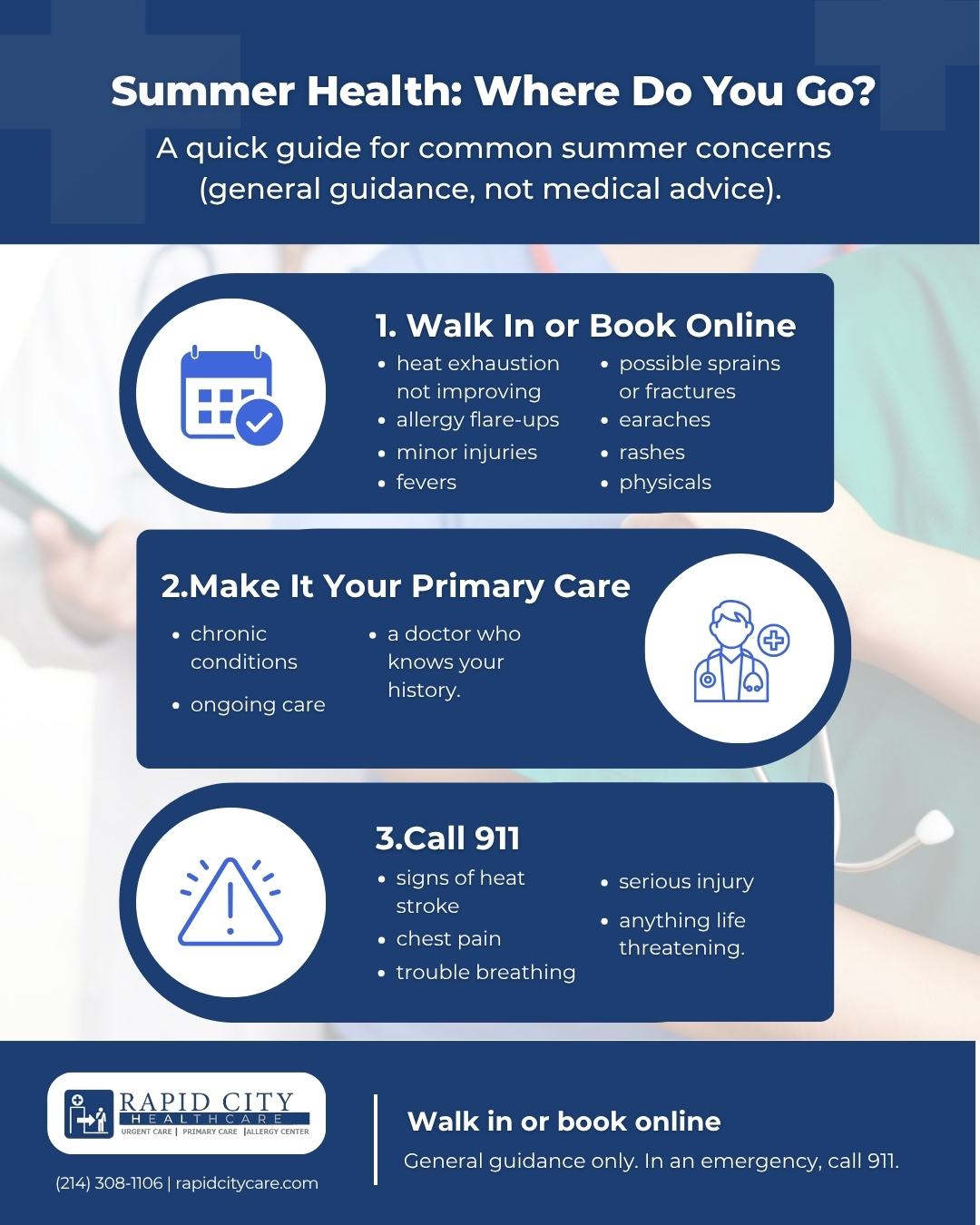
One of the most common summer questions is, where do I go? Here’s a clear way to think about it. For everyday and urgent-but-not-emergency needs, heat exhaustion that isn’t improving, allergy flare-ups, minor injuries, fevers, possible sprains or fractures, earaches, rashes, and physicals, walk in or book online at Rapid City Healthcare. For ongoing care, chronic conditions, and someone who knows your history, that same clinic can be your primary care doctor. And for true emergencies, signs of heat stroke, chest pain, trouble breathing, a serious injury, or any situation that feels life-threatening, call 911 or go to the nearest ER.